
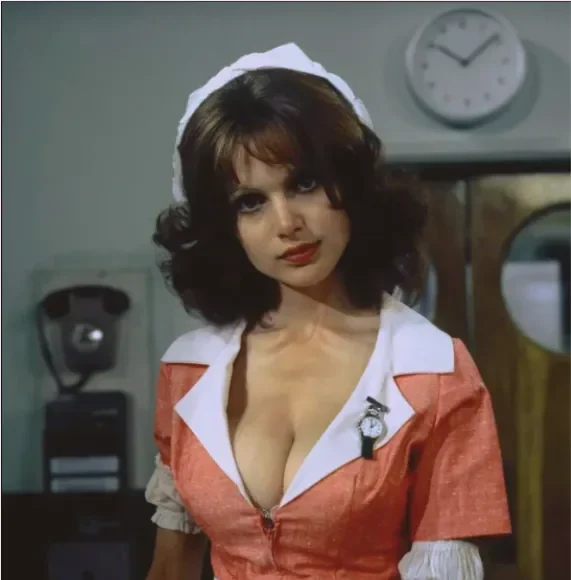
She wore vulnerability like velvet — soft, magnetic, and impossible to imitate. For a brief but brilliant period in the 1970s, Madeline Smith embodied a kind of screen presence that could never be manufactured. While others performed, she seemed simply to exist, radiating charm, innocence, and mystery in equal measure. Though her time in the spotlight was fleeting, it left an impression that lingers, like perfume in an empty room.
Born in Hartfield, Sussex, in 1949, Madeline Smith never set out to become one of British cinema’s most memorable faces. She began her working life as a model, her wide-eyed beauty and natural grace catching the attention of photographers and eventually casting directors. Before long, her fresh-faced look — often described as both doll-like and deeply expressive — made her a natural fit for the cinematic landscape of late 1960s and early 1970s Britain.
Her first steps onto the screen were small but promising. Smith quickly found herself working alongside some of the most celebrated actors of her time. She appeared in comedies, dramas, and, most memorably, horror films, where her unique mixture of innocence and allure became her calling card. It was Hammer Films, the legendary British studio that made Gothic horror glamorous, that gave her some of her most iconic roles.
Smith’s collaborations with Hammer included Taste the Blood of Dracula (1970) and The Vampire Lovers (1970), both of which cemented her status as one of the studio’s most enchanting figures. In a genre often criticized for reducing women to tropes, Smith brought something different. She projected not just beauty, but a quiet depth — a vulnerability that made her characters linger in the imagination long after the credits rolled.
Her career-defining moment, however, came in 1973, when she appeared in the James Bond film Live and Let Die. Cast as Miss Caruso, she played an Italian agent romantically entangled with Roger Moore’s 007. Though her screen time was brief, her appearance became instantly iconic. In the pantheon of Bond women, Smith stood out not because of overt seduction or glamour, but because of her naturalness. She was playful yet poised, her performance imbued with warmth that made the scene unforgettable.
But unlike many actresses who capitalized on the fame of being a “Bond girl,” Madeline Smith seemed uninterested in chasing celebrity. She never allowed herself to be defined solely by that role. Instead, she continued to appear in film and television with selective grace. She popped up in comedies such as Carry On Matron (1972) and television favorites like The Two Ronnies and Doctor at Large, showing her versatility as both a comedic and dramatic actress.
And then, at the height of her fame, she did something rare in the entertainment industry: she stepped away. By the early 1980s, Smith had largely left acting to focus on her family life, choosing private fulfillment over public adoration. For an actress so beloved and so recognizable, her quiet retreat only added to her aura of mystery.
What makes Madeline Smith a legend today is not the sheer quantity of her roles but the quality of her presence. She never seemed to force a performance. Her characters breathed, smiled, and trembled with authenticity. She wore her vulnerability openly, turning it into a kind of strength. Watching her on screen was less about being dazzled and more about being quietly captivated.
Kim Novak’s quietly stunning performance in The Eddy Duchin Story (1956) wasn’t just beautiful—it was unforgettable.
Before she was a Dame, she was nearly banned. What did Helen Mirren do on stage that made politicians furious?
She stepped onto the screen with a scream in 1976’s King Kong—but no one expected the blonde beauty to become one of Hollywood’s most formidable dramatic powerhouses
Even decades later, her impact resonates. Fans of Hammer horror regard her as one of the studio’s finest stars, while Bond enthusiasts place her among the most memorable women to grace the franchise. For those who grew up watching British television and film in the 1970s, her face evokes an era of charm, wit, and understated allure.
Smith herself has occasionally returned to the public eye in interviews and fan conventions, always with a warmth and humility that endears her to admirers. She has spoken fondly of her time in the industry, grateful for the opportunities but never regretful of her decision to walk away. That choice — to prioritize her own life over the relentless pursuit of fame — perhaps explains why her reputation has endured with such respect.
In an industry often built on overexposure, Madeline Smith remains proof that sometimes less is more. Her body of work may not be vast, but its impact is undeniable. She managed to embody an era while remaining timeless, her performances still captivating new generations who discover her through cult classics and iconic roles.
Who was Madeline Smith? She was more than a Bond girl, more than a Hammer ingénue, more than a comedic foil. She was an actress who understood the power of presence, who could communicate volumes with a glance or a smile. She walked away at her peak — and in doing so, secured her place as a legend.
Her story is one of quiet brilliance: a career that burned brightly, briefly, but left a glow that still hasn’t faded. Madeline Smith reminds us that sometimes the most unforgettable stars are not those who shout the loudest, but those who whisper with grace, vulnerability, and timeless charm.
From Basingstoke schoolgirl to international icon… can you name her?
Born on June 10, 1965, in Basingstoke, England, Elizabeth Jane Hurley has spent decades captivating the public eye—not just as a model or actress, but as a pop culture phenomenon whose influence has stretched far beyond the screen. Known for her timeless beauty, sharp wit, and remarkable ability to reinvent herself, Hurley has carved a career that is equal parts fashion history, Hollywood glamour, and entrepreneurial savvy.