
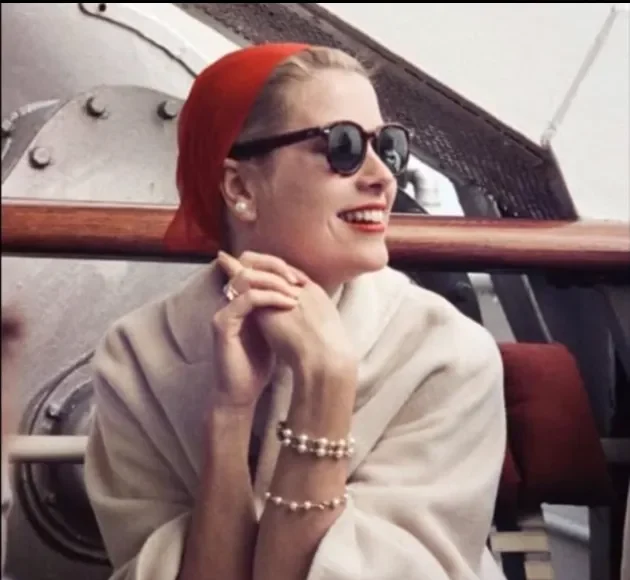
In April 1956, the glamorous world of Hollywood collided with the centuries-old traditions of European royalty when Grace Kelly boarded the SS Constitution to sail toward a new life in Monaco. Already one of the most admired actresses of her generation, Kelly was about to trade the bright lights of Hollywood for the regal halls of the Prince’s Palace, marrying Prince Rainier III in what many called “the wedding of the century.” The images of her aboard the ship remain etched in history—poised, radiant, and calm—as she journeyed from actress to princess.
Grace Patricia Kelly was born in Philadelphia in 1929 into a wealthy and prominent family. Her father, John B. Kelly Sr., was a three-time Olympic gold medal-winning rower and successful businessman, while her mother, Margaret, was a model and physical education instructor. Grace’s upbringing was privileged, but she was determined to pursue her own dreams. Against her family’s initial resistance, she studied acting in New York, honing her craft on stage before Hollywood inevitably came calling.
By the early 1950s, Kelly had established herself as one of cinema’s brightest stars. With her striking beauty, cool elegance, and quiet intelligence, she stood out in an industry often obsessed with glamour over substance. Directors adored her ability to balance vulnerability with strength. Alfred Hitchcock, in particular, saw in Kelly the perfect embodiment of his “icy blonde” archetype—refined on the surface but with a fire that smoldered beneath. She appeared in some of his most celebrated films, including Dial M for Murder (1954), Rear Window (1954), and To Catch a Thief (1955).
Her career reached its pinnacle when she won the Academy Award for Best Actress in 1955 for The Country Girl, a role that required her to strip away her glamorous image and embody a weary, downtrodden wife. Kelly’s win confirmed her as both a star and a serious actress, admired not just for her beauty but for her depth and skill. Yet, just a year later, she stunned the world by announcing her engagement to Prince Rainier III of Monaco.
The story of their meeting is itself the stuff of cinema. In May 1955, during the Cannes Film Festival, Kelly was invited to the Prince’s Palace for a photo shoot. What began as a carefully orchestrated press opportunity soon evolved into a genuine romance. Rainier, looking to secure both a partner and the future of his small principality, was captivated by Kelly’s poise and warmth. She, in turn, found in him a steadiness and sense of tradition that appealed to her. Their courtship was swift, and by Christmas of that year, Rainier was in Philadelphia meeting Kelly’s family and formally proposing.
The announcement of their engagement was a global sensation. Hollywood royalty was set to merge with real royalty, and the world could not get enough. The voyage aboard the SS Constitution in April 1956 became a spectacle in itself. Accompanied by her family, friends, and an entourage that included her beloved French poodle, Oliver, Kelly set sail from New York to Monaco. The press covered her every move, from the gowns she packed—over 50 pieces, many designed by MGM’s top costume designers—to her demeanor on deck.
Photographs from the voyage show Kelly at ease, smiling and chatting with her companions, dressed in chic yet understated ensembles. For the public, these images carried symbolic weight. Here was a woman who had achieved the pinnacle of Hollywood success, yet she was leaving it all behind for love, duty, and the promise of a fairy tale future. The voyage was not just a journey across the Atlantic—it was a passage from one identity to another.
The anticipation reached fever pitch when the ship arrived in Monaco. Thousands of locals gathered to welcome their future princess, lining the streets and waving flags as she made her way to the palace. The wedding itself, held on April 18 and 19, 1956, was a spectacle unlike any other. The civil ceremony was followed by a religious ceremony at the Cathedral of Saint Nicholas, attended by dignitaries, celebrities, and watched by an estimated 30 million television viewers worldwide.Kelly’s wedding gown, designed by MGM’s Helen Rose, remains one of the most iconic bridal dresses of all time. Made of silk taffeta, lace, and thousands of tiny pearls, it perfectly encapsulated the elegance and modesty that defined her. Decades later, it would inspire countless brides, including Catherine, Princess of Wales, whose 2011 wedding gown echoed its timeless design.
For Kelly, the transition was profound. She retired from acting, honoring her new responsibilities as Princess of Monaco. While some lamented the loss of her cinematic career, her life in Monaco became another form of performance—one where she embodied dignity, compassion, and grace. She devoted herself to philanthropic work, supporting hospitals, cultural institutions, and children’s charities. Her humanitarian legacy remains deeply tied to Monaco, and through the Princess Grace Foundation, her influence continues to support artists and young talent around the world.
Yet, beneath the fairy tale, Kelly’s life was not without challenges. Adjusting to royal duties was difficult, and she often missed the creative freedom and camaraderie of Hollywood. She also faced personal struggles, including balancing her role as a princess with her desire for independence. Still, she carried herself with the same poise that had made her a star, embracing her destiny with resilience.
Today, those photographs of Grace Kelly aboard the SS Constitution remain iconic. They capture a moment of transformation, a serene beauty poised between two worlds. Her voyage in April 1956 endures not just as a chapter in her life, but as a symbol of a unique era—when Hollywood and royalty intersected, and one woman’s journey captured the imagination of millions.
Grace Kelly’s story is often described as a fairy tale, but it was also a story of courage. It took bravery to walk away from a thriving career and step into a role that came with immense pressure and responsibility. In doing so, she showed that grace is not just a name, but a way of living—a legacy that continues to inspire nearly seventy years later.
FOX NEWS DECLARES ALL-OUT WAR ON CBS, NBC, AND ABC—JEANINE PIRRO LEADS $2 BILLION CAMPAIGN TO TOPPLE MAINSTREAM MEDIA!
In a shocking move that has sent shockwaves through the media world, Jeanine Pirro has launched a full-scale attack on CBS, NBC, and ABC, with Fox News ready to take on the media giants head-to-head. Armed with a $2 billion battle plan and Tyrus at her side, Pirro is orchestrating a war that could change the media landscape forever. But why are rival networks now scrambling in panic? What secrets lie behind this massive, high-stakes strategy?
Get ready for the shocking details that could alter the course of television forever. Full story below